top of page
California and Canada
A work/play/work/see-friends trip.
September 8-28, 2026
Day 1, Tuesday, September 8, 2026
Travel from home to Irvine, California.
Flight:
Boston (BOS) to Los Angeles (LAX)
Delta Flight: 2004
Departure: 10:55 AM
Arrival: 2:01 PM
Distance: 2,661 miles (4,202 km)
I am at the University of California - Irvine to attend a workshop on MIni CArbon Dating Systems (MICADAS). This a continuation of an inaugural workshop that I organized and hosted at WHOI approximately two years ago.
A pre-workshop dinner was held at The Beachcomber at Crystal Cove, Newport Coast, CA.

The beach at Crystal Cove State Park, Laguna Beach, CA.

The beach at Crystal Cove State Park, Laguna Beach, CA.

Sunset from the restaurant.

Day 2-3, Wednesday-Thursday, September 9-10, 2026
MIni CArbon Dating Systems (MICADAS) workshop at the University of California, Irvine
Ion source for the Accelerator Mass Spectrometry System (AMS) at the University of California - Irvine. The systems is used for Radiocarbon dating.

The low-energy section of the AMS system. The round beige tank on the left is the accelerator, which runs at 500,000 volts.

The high-energy section of the AMS system. The beige thing in the center is the magnet which separates 12C and 13C from 14C (radiocarbon).

The sample preparation laboratory.

Day 4, Friday, September 11, 2026
Travel from Irvine, California to Calgary, Alberta, Canada.
Flight 1:
Santa Ana (SNA) to Seattle (SEA)
Delta Flight: 3694
Departure: 11:59 AM
Arrival: 3:00 PM
Distance: 978 miles (1,574 km)
Flight 2:
Seattle (SEA) to Calgary (YYC)
Delta Flight: 6927
Departure: 7:35 PM
Arrival: 10:15 PM
Distance: 453 miles (729 kilometers)
The airport goes by three names, Santa Ana Airport, Orange County Airport, and John Wayne Airport. They have a 9-foot tall (i.e., 'life-sized), statue of the 'Duke' in the arrivals hall.
As an FYI, the Democratic Party of Orange County, California, is pushing to remove John Wayne's name and statue from the airport because of 'white supremacist, anti-LGBT and anti-Indigenous views' Wayne made in a 1971 interview.

Day 5, Saturday, September 12, 2026
Today we explored the area around Drumheller Valley, Alberta. Highlights included Horsehoe Canyon, the Royal Tyrrell Museum, the 'World’s Largest Dinosaur', and the Atlas Coal Mine National Historic Site.
The area around Calgary is flat and goes almost as far as the eye can see. They grow wheat. Lots and lots of wheat.

Horeshoe Canyon, Kneehill County, Alberta. Given it's name it's obviously a U shaped canyon and was formed by a couple of creeks. The rock layers go back approximately 70 million years when dinosaurs roamed.

A view of the bottom of Horeshoe Canyon.

The Drumheller Valley, Alberta, has one of the richest dinosaur fossil deposits in the world and is also the location of the Royal Tyrrell Museum of Palaeontology.
Personally, I don't understand the over-the-top fascination that many (especially children) have with dinosaurs. However, if your are into such things, this museum is one of the best I have seen.

A Triceratops fossil.

Dimetrodon fossils. Dimetrodons were mammal-like reptiles.


A Giganotosaurus fossil.

A Woolly Mammoth fossil.

The town of Drumheller has lots of 'kitschy' dinosaur themed things including 'Tyra' the
'World's Largest Dinosaur'.

From the mouth of the 'World's Largest Dinosaur' you can get a good view of the Drumheller Valley.
I imagine that Pam would not be happy to have to clean and floss those teeth.

The Atlas Coal Mine National Historic Site. The mine operated from 1936 to 1979 and is now open for tours.

The tipple buildingis where they sorted coal by size and then loaded the coal into boxcars or trucks.

Old machinery inside the tipple building.

Shaker table and sieves used to sort the coal.

They used a battery powered locomotive to haul the coal out of the mine.
They give rides (for a fee of course) on the mine train.

The mine locomotive.

An old GMC truck that very much reminded me of the truck my grandfather had on the farm that I drove when I was 13 or 14.

Day 6, Sunday, September 13, 2026
Fishing the Bow River near Calgary Canada.
Today was not a great day for catching. It was cold with temperatures in the 40's and a strong 20-25 mph wind directly up river. I only hooked three fish and landed none.
Hopefully tomorrow will be a better day.
No fish landed.... So no fish pictures.
Day 7, Monday, September 14, 2026
Fishing the Bow River near Calgary Canada.
The Bow River flows into the Oldman River in southern Alberta to form the South Saskatchewan River, which ultimately empties into Hudson Bay. It is 1,370 mi (2,200 km) from Calgary to the Hudson Bay.
Weather was cold and windy. Gusts of about 30 mph. But we did manage to catch a few small fish.
The Bow River south of Calgary.

A small rainbow trout.

Deer alongside the river.

Warning, the below was NOT approved by Pam
Using some basic physics and several assumptions (such as water flows freely, no evaporation loss, no groundwater recharge, etc.), it would take about 30 days for a drop of water to flow from Calgary to the Hudson Bay.
Taking that further, it means that if I pee in the river (and I'm not saying that I did or didn't) that on or about October 13, 2026, about 20 septillion atoms of my pee will enter Hudson Bay. Written out, that is 20,000,000,000,000,000,000,000,000 atoms of pee.
Day 8, Tuesday, September 15, 2026
Fishing the Bow River near Calgary Canada.
Weather was cold and overcast. Highs in the mid 40's.
We moved (i.e, got them to eat) several trout. Hooked a couple. But never were able to land any. A combination of barbless hooks and poor slack line management on my part were to blame.
'City Section' of The Bow River.

Our drift boat.

Day 9, Wednesday, September 16, 2026
Canmore, Alberta and Banff National Park, Canada
Highlights: Grassi Lakes Trail, downtown Canmore, Alberta, and Fairmont Banff Springs Hotel
Weather was beautiful. Started out foggy, but cleared up, highs in the upper 60's.
Hiking the Grassi Lakes trail. Canmore, Alberta in the distance.


Grassi Lakes waterfall.
Grassi Lake.

Downtown Canmore, Alberta.

Upper Bow River.

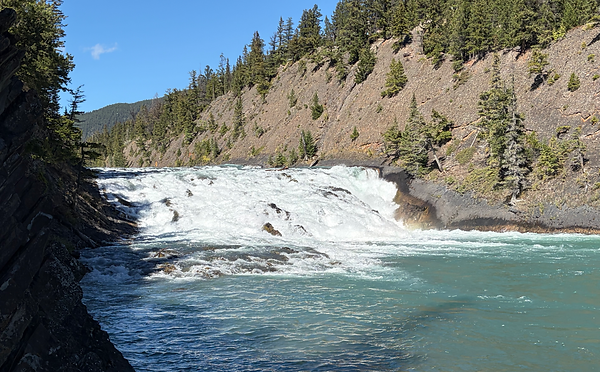
Bow falls.
View from Fairmont Banff Springs hotel.

For reasons that I don't know, we got upgraded to a 1-bedroom suite.
This is the view from our hotel window.

Another view from our hotel window.

We ate at the Waldhaus (Forest House) restaurant. From the name you can probably deduce that they serve German food. Pam had Schnitzel.

I had Bratwurst.

Day 10, Thursday, September 17, 2026
Banff National Park, Canada
Weather was great. Skies clear. Started out cold at ~ 36° F but warmed up to upper 60's.
In the morning we hiked to the top of Tunnel mountain. This is view of our hotel from the top.

A view of the Bow Valley in Banff National Park from atop Tunnel Mountain. The hike was 4.8 km (3 miles) round-trip and had an elevation gain of 260 m (850 ft).

A closer view of Fairmont Banff Springs from the top of Tunnel Mountain. Our room was right in the center tower, near the top.

A view of the Fairmont Banff Springs Golf Course from atop Tunnel Mountain.

In the afternoon we rode the gondola to the top of Sulphur Mountain for views of six mountain ranges and the Bow River Valley. Tunnel moutain, the hill we hiked up in the morning, is that small hill in the center.

A closer view of the Fairmont Banff Springs from atop Sulphur Moutain. Tunnel moutain is behind the hotel.

The Bow Valley.

At the top of Sulfur Mountain.

The terrace of the Fairmont Banff Springs hotel.

The 'Secret Garden' on the terrace.

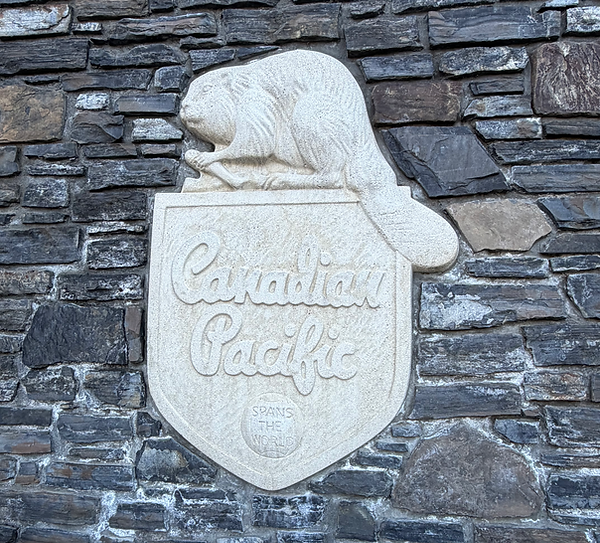
The Fairmont Banff Springs hotel was orginally opened in 1888 by the Canadian Pacific Railway as one of Canada's grand railway hotels.
For dinner, I had Bison ribeye.

Day 11, Friday, September 18, 2026
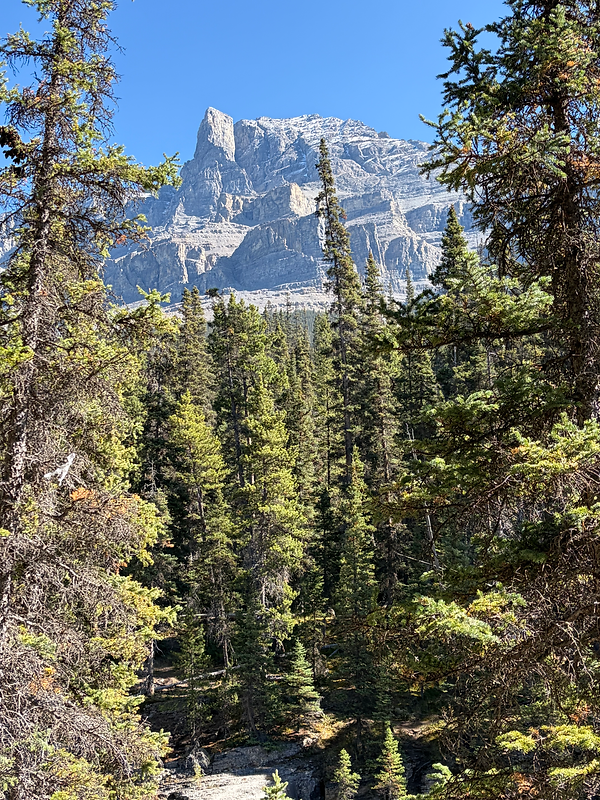
We drove from Banff to the Columbia Icefields and then back to Lake Louise, Alberta. The road we took is called the Icefields Parkway and is ranked by National Geographic as the prettiest road in North America.
The Icefields Parkway.

Athabasca Glacier.

Our ride to the Athabasca Glacier.

On the Athabasca Glacier.

Athabasca Glacier.

Columbia Icefields Skywalk. A glass-floor observation platform with a 280 meter (948 foot) drop. I didn't particularly like looking down.

Columbia Icefields Skywalk.

View from Columbia Icefields Skywalk.

Mistaya River.

Mistaya Canyon.

View from Mistaya Canyon.
Peyto Lake.

Day 12, Saturday, September 19, 2026
In the morning we hiked to Agnes Lake, Alberta and had lunch at the Agnes Lake Tea House. In the afternoon, we rode the Lake Louise Summer Gondola for views of Lake Louise Valley.
Early morning view of Lake Louise from our hotel window.

Mirror Lake with the Beehive in the background.

Lake Agnes.

Lake Agnes Tea House. It isCanada's oldest operational tea house. It is a 3.5 km (2.2 miles) one-way hike with an altitude gain of 1300 feet. The tea house operates with no running water or electricity. Staff members backpack fresh supplies up the mountain trail every single day and carry out all refuse.


The menu at the Lake Agnes Tea House. The homemade bread was really good.

The waterfalls coming from Lake Agnes.
View of Lake Louise Valley on the trail coming down from Lake Agnes. Our hotel is just visible at bottom center.

A view of Lake Louise Valley from the top of Lake Louise Summer Gondola. Victoria Glacier in the distance.

Our hotel.

Day 13, Sunday, September 20, 2026
Today we drove from Lake Louise, Alberta to Nelson, British Columbia with a few stops alonge the way. For the next 5 days, I will be attending the 10th International Symposium on Negative Ions, Beams and Sources (NIBS2026). For the meeting, I'm on the International Advisory Committee, I give a talk on Monday, and I chair a session on Wednesday.
Bull Elk alongside the road.

Yoho River.

Takakkaw Falls

Takakkaw Falls

Yoho River.

A wildlife crossing bridge. Built so that animals can cross from one side of the road to the other.

Bear Creek Falls. We didn't see any bear. Or anybody from Missouri either.

Bear Creek Falls.

The Giant Cedars Boardwalk Trail through a 500-year-old old-growth cedar forest.

The Giant Cedars Boardwalk Trail.


To get from Lake Louise, Alberta to Nelson, British Columbia, we had to take a ferry across the Columbia River and Upper Arrow Lake.
Upper Arrow Lake and the Columbia River.

Day 14-18, Monday-Friday, September 21-25, 2026
At the 10th International Symposium on Negative Ions, Beams and Sources (NIBS2026) hosted by the Selkirk Ion-source Research Centre (SIRC) in Nelson, British Columbia, Canada.
Dr. Baoxi Han from the Spallation Neutron Source at OaK Ridge National Laboratory. Baoxi was my first post-doctoral student some 20+ years ago.
It was very good to catch up with him.

Baoxi won a conference award for his work on ion sources.

Day 19, Saturday, September 26, 2026
Kananaskis Valley

Kananaskis Valley

Kananaskis Valley

A couple of doe.

Alberta Highway 40 south of Kananaskis Village

Alberta Highway 40 south of Kananaskis Village

Free range cattle.

Day 20, Sunday, September 27, 2026
Alberta Legislature Building. Edmonton is the capital city of the province of Alberta.

Our friends Deb and Jim.


Day 21, Monday, September 28, 2026
Return home.
Flight:
Calgary (YYC) toBoston (BOS)
Delta Flight: 7058 (Code share with Westjet 1624)
Departure: 10:50 AM
Arrival: 5:40 PM
Distance: 2,099 miles (3,378 km)
bottom of page